Navigating Proof of Funds for Canadian Study Permits from Ghana: What Visa Officers Actually Look For
Money is the biggest reason Ghanaian study permits are refused. Learn the exact bank statement history, source-of-funds evidence and sponsorship documentation IRCC officers expect from West African applicants.
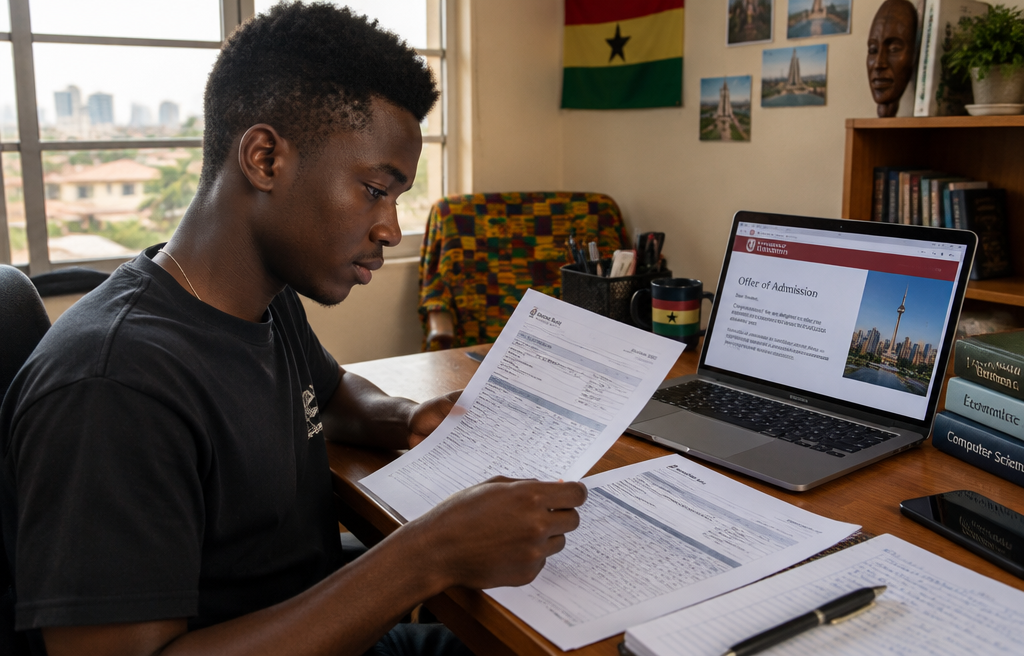
Money is the single biggest reason Canadian study permit applications from Ghana are refused. Not grades, not the school, not the statement of purpose — the money. Visa officers at IRCC refuse thousands of West African applications every year under one short sentence: "I am not satisfied that you have sufficient funds available." This guide explains exactly what officers look for in proof of funds from Ghana, how sponsorship works, and how to structure your finances so your application survives scrutiny.
The Numbers You Must Meet in 2026
Before anything else, know the floor. For a single student studying outside Quebec, IRCC expects you to show:
- First-year tuition — as stated on your letter of acceptance, typically CAD 18,000–35,000 depending on the programme
- Living expenses — CAD 20,635 per year (the figure IRCC raised in 2024 and now adjusts annually)
- Return transportation — a reasonable allowance for flights between Accra and Canada
Note that the former Student Direct Stream (SDS) — the fast-track route built around a Guaranteed Investment Certificate — was discontinued by IRCC in November 2024. All applicants now go through the regular study permit stream, where you must show these totals through bank statements, sponsorship documents and the other proofs listed on IRCC's proof of financial support page. A GIC from a participating Canadian bank remains strong supporting evidence even though the dedicated stream is gone.
Always confirm the current figures on the official IRCC study permit page before you apply — the living-expense threshold changes.
What Visa Officers Actually Examine
Officers are not just checking that a number is big enough. They are reconstructing the story behind the money. These are the four tests your documents must pass.
1. History, not just balance
A statement showing GHS 400,000 today means little if the account held GHS 3,000 for two years. Officers typically want four to six months of statements showing a stable or logically growing balance. A sudden large deposit weeks before your application is the classic red flag — it suggests borrowed money that will vanish after the visa decision.
2. Source of funds
Every significant deposit should be traceable. Salary credits match an employment letter and payslips. Business income matches tax records, invoices or company registration. Sale of an asset — land, a vehicle, shares — needs the sale agreement. If you cannot document where the money came from, the officer assumes it is not really yours.
3. Access and liquidity
The funds must be available to you now. Fixed deposits, treasury bills and investment accounts can support your case, but they must be accompanied by evidence they can be liquidated. Land titles and buildings are assets, not proof of funds — officers cannot pay your rent in Toronto with a plot in Kasoa.
4. Consistency across documents
Your bank statement, employment letter, tax records and statement of purpose must tell the same story. An applicant who claims a GHS 12,000 monthly salary but shows GHS 2,500 salary credits will be refused for misrepresentation risk, not for lack of money.
Ghana-Specific Traps to Avoid
- Mobile money balances. MoMo statements alone carry little weight. They work best as supporting evidence of business turnover, alongside a proper bank statement from a licensed bank.
- Undocumented family support. Money sitting in an uncle's account is not your money until the sponsorship is formalised (see below).
- Forex fluctuations. Officers convert cedi balances at current rates. Build a buffer of at least 10–15% above the IRCC minimum so a cedi slide between printing your statement and the decision does not push you below the threshold.
- Printed "statement" fraud. Doctored statements are the fastest route to a five-year ban for misrepresentation — IRCC's fraud-consequences page spells out the five-year ban. Officers verify with banks. Never let an agent "arrange" a statement for you — and verify anyone you work with through our official channels on our fraud alert page.
Sponsorship: How to Do It Properly
Most Ghanaian students are sponsored — by parents, a spouse, a sibling abroad or an employer. Sponsorship is perfectly acceptable, but it must be documented like a legal arrangement, not a verbal promise. A complete sponsorship package contains:
- A signed sponsorship letter or affidavit stating the relationship, the sponsor's commitment, and the duration of support. Affidavits sworn at a Ghanaian court add weight.
- The sponsor's bank statements — the same 4–6 months, the same history and source-of-funds tests applied to you.
- The sponsor's proof of income — employment letter and payslips, or business registration and tax records for self-employed sponsors.
- Proof of relationship — birth certificates, marriage certificates or other civil documents linking you to the sponsor.
- The sponsor's identification — passport or national ID copy.
A sponsor living abroad should additionally provide their residence status and foreign bank statements. An officer must be able to answer, from your file alone: who is paying, why are they paying, and can they genuinely afford it?
The Three Financial Tiers — and Which One Fits You
- Tier 1 — Self-sponsored with strong history: You earn well in Ghana and your own statements cover tuition plus living costs. Simplest case; the officer sees independence and strong home ties.
- Tier 2 — Sponsored by immediate family: The most common Ghanaian profile. Works when the sponsor's finances are documented as rigorously as yours would be.
- Tier 3 — Scholarship, loan or mixed funding: Scholarships need the official award letter stating the covered amount. Bank loans need the approval letter and disbursement terms. Mixed funding (part scholarship, part family) must show each component adding up to the full requirement — gaps are refusals.
Whichever tier you are in, the totals must meet the IRCC floor. Partial funding with a vague promise to "find the rest" is one of the most common refusal triggers we correct in reapplications.
Practical Checklist Before You Submit
- Six months of bank statements, stamped by the bank
- Tuition payment receipt and, where available, a GIC or equivalent liquid funds covering living expenses
- Sponsorship affidavit plus the sponsor's full financial file
- Source-of-funds evidence for every large deposit
- Currency buffer of at least 10% above the minimum
- A short financial summary letter tying all documents together
How Secure Travel and Tours Can Help
We review proof-of-funds files for Ghanaian applicants every week — restructuring statements, documenting sponsors properly and catching inconsistencies before an officer does. Book a 45-minute study abroad consultation (GHS 300) and bring your statements; we will tell you plainly whether your file is ready. You can also explore our study abroad services for school selection, SOP writing and full application management, and register for IELTS in Ghana through our official partner link.
Disclaimer: We do not guarantee visa approval. Final decisions rest solely with Immigration, Refugees and Citizenship Canada. Figures quoted are 2026 estimates — always verify current requirements on the official study permit pages before applying.
Frequently Asked Questions
How much money do I need to show for a Canada study permit from Ghana in 2026?
For a single student outside Quebec you must cover first-year tuition (per your letter of acceptance, typically CAD 18,000–35,000), living expenses of CAD 20,635 per year, and return transportation. Under SDS this is proven with a CAD 20,635 GIC plus a tuition payment receipt; the regular stream accepts bank statements and sponsorship documents instead. Verify the current living-expense figure on canada.ca, as IRCC adjusts it annually.
How many months of bank statements does IRCC want from Ghanaian applicants?
Four to six months is the working standard. The officer is assessing history and source of funds, not just the closing balance — a large recent deposit without documented origin is a common refusal trigger. Build a buffer of at least 10% above the minimum in case the cedi weakens between printing your statement and the decision.
Can a family member sponsor my Canadian study permit from Ghana?
Yes, and most Ghanaian students are family-sponsored. The sponsor must provide a signed sponsorship letter or sworn affidavit, their own 4–6 months of bank statements, proof of income (employment letter and payslips, or business registration and tax records), proof of your relationship, and a copy of their ID. The sponsor's file is examined as rigorously as yours.
Does IRCC accept mobile money statements as proof of funds?
MoMo statements alone carry little weight because balances are volatile and hard to verify. They work best as supporting evidence of business turnover alongside a stamped statement from a licensed bank. The core proof should sit in a verifiable bank account or a GIC.
Can Secure Travel and Tours guarantee my study permit will be approved?
No. We do not guarantee visa approval — final decisions rest solely with IRCC. What we do is review and structure your financial file so it answers the officer's questions clearly, which is where most Ghanaian applications fail.